
Network
SD-WAN Works Great — Until Your Network Doesn't
30 Apr 2026
Most SD-WAN solutions assume one thing:
That your network is reasonably stable.
Low packet loss. Predictable latency. Clean links.
That assumption holds in datacenters and well-connected sites.
But in many real-world deployments, it breaks down.
The Reality of Unstable Networks
Outside controlled environments, network conditions are rarely ideal.
Typical scenarios include:
- LTE and wireless connectivity
- Remote or distributed sites
- Industrial and field deployments
- Long or unreliable last-mile connections
These environments introduce:
- Packet loss
- Jitter
- Variable latency
- Intermittent connectivity
This is not an edge case — it is the baseline for many networks.
Where Traditional SD-WAN Falls Short
SD-WAN solutions are effective at:
- Routing traffic
- Managing multiple links
- Providing visibility
But they generally assume that the underlying links are usable.
When packet loss increases, application performance still degrades:
- Real-time traffic becomes unstable
- Throughput drops
- Latency becomes unpredictable
At that point, routing decisions alone are not enough.
Treating Packet Loss as a First-Class Problem
Instead of assuming a clean network, another approach is to design for imperfect conditions.
Forward Error Correction (FEC) does this by adding redundancy to traffic.
Lost packets can be reconstructed without retransmission, allowing traffic to remain usable even under degraded conditions.
This changes the problem from: "How do we avoid bad links?"
to: "How do we make traffic resilient on bad links?"
NanoPing: SD-WAN Built for Unstable Networks
NanoPing is designed around this principle.
It combines:
- Forward Error Correction (FEC)
- High-performance link bonding
- Deployment on existing hardware
This makes it particularly relevant in environments where traditional SD-WAN struggles.
Designed for real-world conditions
NanoPing is commonly used in:
- Branch offices with weak connectivity
- LTE and wireless setups
- Industrial and field environments
- Distributed systems over unreliable links
No proprietary hardware
NanoPing runs on standard infrastructure.
There is no requirement for dedicated appliances or vendor-specific hardware.
High-throughput bonding
Multiple connections can be combined to improve both throughput and resilience.
Visibility and Monitoring
NanoPing also provides detailed insight into network behavior.
This includes:
- Traffic monitoring
- Performance visibility
- Custom dashboards
However, the primary focus is not observation.
The goal is to improve how traffic behaves under real network conditions.
Learn More
Technical details and documentation are available here:
When NanoPing Is Relevant
NanoPing is not intended for all environments.
In stable, high-quality networks, the benefits are limited.
It becomes relevant when:
- Packet loss affects application performance
- Connectivity is unstable or wireless
- Infrastructure is distributed or remote
Try NanoPing
NanoPing can be tested directly in your own environment:
Discuss Your Setup
For teams evaluating SD-WAN solutions or running production infrastructure, it is often useful to review specific requirements:
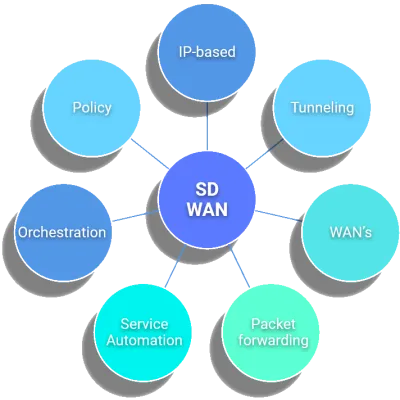
Image by SD-One via Wikimedia Commons, CC BY-SA 4.0

Would you like to develop a custom solution?
We'd love to hear from you. Whether you have a question about features, pricing, or anything else, our team is ready to help.
Contact us